After just a few days back in Sardegna after our trip to Napoli, we set off fo

r the Datca peninsula of Turkey for a week-long sailing expedition followed by a few days in Istanbul. As I had been longing to go to Turkey for many years, fascinated by the human history in that part of the world, this was a very exciting opportunity. We started off with a night in Bodrum, a tourist port about an hour’s flight south of Istanbul, where we saw row upon row of Turkish gulets, the beautiful wooden daytrip boats, set in the harbor next to the Castle of St. Peter, built by the Knights of St. John in the 1400’s apparently using pieces of marble from one of the seven wonders of the ancient world, the 4th c. B.C. tomb built for King Mausalus by his sister and wife, Artemesia. Initially, we were concerned about our complete lack of comprehension of the Turkish language, but our fears were quickly assuaged by the amount of English that we heard spoken, primarily by restaurateurs trying to draw us into the clutches of their establishment before the next heckler had his chance. It was a bit overwhelming, but we eventually settled on a place right on the beach where we had a lovely dinner and watched the ubiquitous Turkish flags flapping in the evening breeze. We decided that it must be a governmental mandate that every boat, business, and flagpole bear a Turkish flag.

The next morning, we caught a ferry to the Greek Island of Kos, where we were scheduled to meet our sailboat. It seems obvious, but somehow it surprised me to be surrounded by not only an unfamiliar language, but unfamiliar letters as well, although I was able to recall a bit from my high school days as a Classics nerd. We took in a bit of Kos including Hippocrates’ plane tree and an amazingly preserved Roma

n village that wasn’t marked with a even a single sign. There were intact paintings on the walls, beautiful mosaic floors, and dramatic arches of what appeared to have been a bathhouse. It is amazing to find such ancient treasures quietly existing nearly everywhere we have been in Europe. From here, we began our journey with Seascapes on the Vassilis, with Captain Simon at the helm and a crew of four other passengers. Our sister boat, the Anna Maria, had just come in from a week in the Greek Islands and would be joining the Vassilis for the week in Turkey. After getting to know our fellow shipmates over dinner, we spent our first night on the boat getting used to the small quarters and to bumping various limbs into bulkheads and other hard parts of the boat. The next morning, we were off to Turkey, floating over tranquil seas with nary a breeze to justify raising our sails. As we entered into Turkish waters, we lowered our Greek standard and raised the Turkish one, as the two countries don’t have the friendliest of histories with each other. The landscape has an animal-like quality with undulating brown, rocky hillsides punctuated by clusters of white stucco houses plunging down into deep blue Aegean waters.
Our first anchorage was in the small village of Ova Buku, where we enjoyed a lovely walk up the

road to the next “town” over before dinner at Ogun’s Place, one of a few seaside tavernas tucked in the cove. The spread of mezzes, or small plates, was wonderful with hummus, sweet chili spread, Coban salatasi (shepherd’s salad) with mint and parsley, and seasoned meatballs which were amusing called lady’s legs. Then, we were all called into the kitchen where we got to choose our main dishes and, though

I was already quite full, I managed to still have room for some moussaka. The tavernas here are reminiscent of the beachside places on the Baja peninsula in Mexico with thatched palm roofs overhanging tiled patios surrounded by dangling vines of bougainvillea. We had a beautiful hike the next morning up the ridge overlooking the bay, followed by a quick plunge to cool off before heading off to the next port. It was another warm, still day filled with much reading on the deck and cool drinks in the sun while sadly the sails stayed furled.
Datca, our second anchorage, was a more developed town with many boats in its harbor and a bustling carpet trade on the main street. It was also a longed-for destination for several of the

Anna Maria crew who had been anticipating a Turkish bath at the local hamam after spending over a week developing a good salt crust. We contented ourselves with a hot afternoon spent on the beach sprawled out next to a group of women having a picnic, clad in headscarves and long skirts, wondering what they thought of the tourists sunbathing in their bikinis. The hours were punctuated by periodic calls to prayer broadcast from the loudspeakers of the mosque minarets. Turkey is a strange mix of western style and Islamic tradition where calls to prayer often seem all but ignored and Turkish women in short skirts walk along the same streets as those fully covered. Once the heat subsided, we went for a long walk through town along the waterfront and then back through the residential area of town, which contained a curious mixture of apartment buildings interspersed with farm animals such as cows, chickens and goats. With our Turkish phrasebook in tow, we practiced "teshekelur ederem," or thank you, after browsing the l

ocal honeys and spices at a few of Datca’s shops, and then returned for evening cocktails on the Vassilis. We had a wonderful mix of personalities aboard with a couple from Seattle, for whom this was the second Seascapes expedition, and their brother-in-law and his son, and Simon, our trusty skipper who always had a curious sailing fact or puzzle to amuse the group. The next morning, we had a guided tour of the old part of Datca, a strangely reconstructed

maze of winding cobblestone streets and timbered houses, the style of which was mandated by the Turkish government in order to preserve the heritage of the original town. The cost of our trip was the requirement that we sit through a carpet demonstration put on at the shop of our tour guide, where we were dazzled by whirling carpets spun out onto display by barefoot men touting the number of thousands of knots per inch and the quality of the all natural dyes used to create these kaleidoscopic and colorful designs – all while sipping Turkish cay (tea) out of the traditional hourglass shaped glass tea cups. Somehow, we all returned to the port carpet-free, and in time to prepare for our departure.

The next spot was one of our favorites from the trip – a small cove called Dircek, where there was one other boat and only a single taverna. While the day started out very calm and hot, the breeze picked up in the afternoon and we were finally able to sail. We attributed our good luck to the morning’s consumption of the last banana left in the galley, having heard that bananas brought bad sailing luck. The magic of the quiet movement of the boat
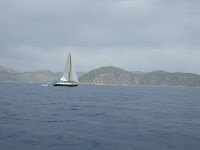
through the water was further heightened by the appearance of a pod of dolphins off the bow, zipping along so closely that we could actually hear their whistles underwater. The crew was in great spirits snapping away photographs and

wondering at our crisp white sails finally hoisted and full of wind. The cove that we tucked into was barely visible from the water as its entrance was quite narrow but, upon entrance, we were greeted by lovely steep green hills dotted with trotting goats enclosing a perfectly tranquil bay with crystal clear inviting waters. Of course, we had to test out both the waters and our goat-footedness by hiking up the ridge followed by a pre-dinner plunge. The taverna was a simple, family-run restaurant, but served fresh tzaziki, mucver (zucchini fritters), more of our new favorite chili paste, and grilled Cipura (sea bream), a local fish we had seen on our swim. It was a deliciously quiet evening perfect for a good night’s sleep.

The next morning started off cooler than most such that we especially enjoyed the warmth of our morning coffee on deck before getting underway. Once out of the safety of the cove, we discovered a light breeze which carried us most of the way to Bozburun, our next por

t of call, where Chad was eagerly awaiting a much-touted Turkish shave and had saved up a bit of stubble in preparation. Bozburun was a small port town known for the construction of gulets, the dayboats we had seen in Bodrum. On our walk through town, we saw several frames of boats-to-be atop wooden cradles surrounded by fields with cows and goats. The gleaming varnished hulls of the completed boats, ready to head out to the tourist ports, lined the waterfront. This was all viewed along the path to the aforementioned Turkish shave which was, indeed, quite an experience, or at least for me to watch, and the final product was definitely worth more than 5 YTL (Turkish Lira).


In the evening, following another tasty taverna dinner, the Vassilis crew retired to the boat for a vicious game of Scrabble which began with the two of us playing each other and progressed to include the other crew members taking one side or the other to the end result of a winning 83 point word using all seven letters (much to Chad’s chagrin).
The sailing continued to be good on the following day and, as we didn’t have a lot of distance to cover, we were able to follow the wind a bit and also to stop

along the way to see the ruins of a Roman villa of sorts that Simon remembered from voyages past. We quickly discovered that the goats had taken up residence in one of the still-standing smaller structures and got a bit of a scare upon peering in. Walking up the hillside, we discovered wild thyme and sage that sweetened the breeze a bit against the scent of the goats. It was hard to tell what we were looking at, but it was another amazing example of ruins likely over 1000 years old completely unlabeled much like those we saw in Kos. Eric an

d Paul cooked up a fantastic hot lunch of sausages and Babs made potato salad, all of which we feasted upon in the sun while anchored in the cove and which exacerbated the slow pace of our afternoon. Eventually, we made our way to Sailor’s Paradise, a cove similar to Dircek in its hidden position and tranquility. The taverna there had beautiful gardens out back filled with flowers and vegetables, many of which we enjoyed with our dinner that night. Spurred by last night’s festive game playing, in the evening we played Pictionary down in the galley accompanied by a bit of the local coffee-anise flavored after dinner drink.
Sadly, we came to our last day of sailing, as we had to return to Datca in order to get various

people on ferries and flights home. But, we had our best sailing yet, reaching a record 5.18 knots, which I proudly announced while at the helm. We took another side trip, as we were in no hurry to return to Datca, to see an old church or monastery p

erched on hillside and guarded by a large donkey. There was a beautiful mosaic floor made of smooth black and white beach stones arranged in star patterns and pictures of animals and a tree in front of the doorway to the small building that was covered in pieces of paper and ribbon tied to its branches something like prayer flags. We guessed that maybe it was originally Islamic, given the animal designs in the mosaic but, again, there were no official clues to its history. Inspired by yesterday’s lunch a
nd, shockingly missing pasta, I made a sort of Mediterranean pasta salad which we ate on the deck with glasses of wine in disbelief at how beautiful our surroundings

were and how lucky we were to be there. Datca wa

s, once again, very hot and, after wandering around a bit in the evening, we sought refuge at a tea garden along the water where Chad sampled ayran (a local yogurt drink) and I had a quite strong Turkish coffee. For our final dinner, the Vassilis crew decided to head off on our own to a restaurant in town that a friendly English-speaking shopkeeper had recommended to us. We had fantastic moussaka, corba (garlic soup), and farmer’s salad, among other things, for a grand total of 50 YTL for seven people, leaving us plenty to buy a box of deliciously sticky baklava to pass around from the bakery down the street. It was a great final night.
The last few days of our trip were in Istanbul, having taken a ferry back to Bodrum and then a short flight from there. Istanbul was a much larger city than we’d anticipated with nearly 15

million people in the city sprawling across the Bosporus from the European to the Asian continent. We stayed in the Sultanahmet neighborhood, the heart of the old city, which was still surrounded by amazingly intact tall stone walls. Our first adventure was trying to get dinner down at the fish market along the waterfront, which we had noticed on our way in from the airport. Innocently thinking that we could stroll along looking at the various seafood and then stop at a restaurant of our choosing, we were instead immediately assaulted by, “Hey lady, want to see my fish,” and “Where are you from? You come eat at my restaurant – best one in town. I give you my word,” followed by “where are you going, my friend. Just one minute – come and have a look inside. I give you free desert.” Finally worn down by the hecklers, we escaped inside the last restaurant in the row and managed to have a wonderful dinner of seafood antipasti, fearing the cost and the cleanliness of the whole fish that may have come from the Bosporus, whose waters were clogged with innumerable tanker ships. Indeed, the waiter did bring out bananas and strawberries drizzled with honey and chopped nuts – the promised freedesert.
While in Istanbul, we braved the Kapali Carsi, the largest covered

bazaar in the world with over 4000 shops, where you can buy everything from carpets to genie lamps, but where you must be prepared to bargain. We were relieved to find that the heckling here was nothing compared to last night’s dinner

experience and, once we got into the swing of bargaining, we managed to purchase a few things for just about half the asking price by using the new-found power of just saying “no” and walking away. The spice market, scattered outdoors, contained stall after stall of all varieties of the taffy-like Turkish delight as well as perfectly sculpted mounds of spices of every color and texture. And, a third market was known for its live pets for sale, which included leeches squirming around in large glass jars. Visible from the roof-deck of our hotel and onl

y a short walk away, was the famous Blue Mosque, which was, at the time of its construction in 1609, controversial because its six minarets were said to rival those at Mecca. I made use of my newly purchased scarf to cover my head upon entrance and my too-short skirt was deftly covered by a large blue sheet provided by the man guarding the door. Walking around barefoot and cloaked, I got a small taste of what it would be like to be a young Islamic

woman living in Turkey. Inside the mosque, the tilework lining the domes was amazing and was brightened by light coming through colorful stain glass windows and filtering onto the carpeted floors. A group of men were in prayer, repeatedly standing up and kneeling down, facing to the east, reminding us that this is still a place of worship. This was in contrast to the

Aya Sofya, which was originally built in 360 AD as a Christian church in the time of Constantine, was then converted into a mosque by the Ottomans and, most recently, into a public museum. The mosaics there were the most striking we saw with the careful coloration and patterning of the tiny tiles lending very expressive looks to the people portrayed. The Arabic writing on the walls contrasted with the figures of Virgin and Child above the altar. We also visited the Suleymaniye mosque in the large complex overlooking the old city on one of the original seven hills of Constantinople, modeled after those of Rome, no doubt, and built by renown Ottoman architect Mimar Sinan in 1550. On a recommendation from friends, we went to the Yerebatan Sarayi, an underground cistern built by Emperor Justinian to collect water from the Belgrade Forest brought in by aqueducts. It had been very well restored following the removal of 50,000 tons of mud to expose the many columns filling its dimly-lit caverns. There were even fish in the shallow pool beneath our feet and water eerily dripping from above.
During our wanderings around town, we had passed a movie theater and

noticed that Orumcek Adam 3, or Spiderman 3, was playing, and decided to take advantage. It may seem a bit strange to see a movie while in Istanbul for only three days, but, living in Sardegna, we are a bit short on opportunities or, at least, those in a language we can understand. The wonderful thing about movies in Turkey is that they are in English with Turkish subtitles and, even better, they have an intermission during the movie for an often badly needed shot of caffeine. It also provided a welcome rest from all of the walking we had done around the city.
Curious to see what the newer part of Istanbul was like, the next day we ventured across the Golden Horn to see Beyoglu. It was much like any large European city in feel and was a bit of a disappointment after being among the twisting narrow streets of the Sultanahmet. While walking down the main street, we noticed large phalanxes of police in riot gear surrounding a public square, but with no real crowd in site. Later, we heard that there had been a protest, much like those the day before in Izmir, of people against the current government’s religious leanings and in favor of a more secular state. Turkey has such an interesting history from Constantine to the Ottomans to Ataturk and now the present situation of trying to gain entrance into the European Union.
That night, we reconvened with the Vassilis crew minus Simon, as they had all stayed in the Istanbul as well. We had a wonderful dinner at the Mosaik Café where we sampled manti, the East Anatolian version of meat-filled ravioli in a spicy pepper-yogurt sauce, and delicious lamb cooked in clay pot. After dinner, we enjoyed a bottle of wine and more baklava on the roofdeck of our hotel, before finally saying goodbye. We were very lucky to be with such a good group of people for our trip.
O

ur final site on our final day was the Topkapi Palace, home to Sultans from the 14th century through the mid-19th. There were displays of lavish carpets, ceramics from the far east, weaponry from as far back as the 5th century, and amazing jewels from throughout the empire, including the famous 86 carat Spoonmaker’s diamond and the Topkapi dagger with egg-sized emeralds set into its handle. Perhaps the most interesting were the relics of St. John the Baptist – his arm encased in g

old armor and his skull in a gold and jewel-encrusted crystal box. We wondered how this Christian relic ended up in the palace of an Islamic ruler. We visited the harem as well, where we imagined the young girls living under the auspices of the Queen Mother, all being groomed to please the Sultan. The systems of hierarchy and subjugation at the palace were amazing with every group living on the grounds belonging to a ranked society. We decided that perhaps the safest, happiest

existence within the grounds might be that of a bird in the beautiful courtyard gardens who would actually be free to come and go as he pleased, unlike most of the subjects employed there. After our tour, we found lunch outside the palace gates at a gozleme café, where we watched a scarved woman roll out large flatbread pancakes and cook them on a flat iron skillet next to our table. There was just enough time for Chad to have one last Turkish shave before we had to head off to the airport, thus concluding our Turkish adventure. It is definitely a place that we would like to return to, our curiosity peaked by the little that we were able to see. It is a rare place in that it is culturally quite different but, at the same time, fairly accessible so that one does not feel completely overwhelmed.
Now, we are back in Sardegna, where summer is upon us with temperatures increasing, both water and air, and, with that, increasing numbers of tourists as well. We very much look forward to staying relatively put for a couple of months and taking in things here while reflecting upon our many spring adventures.
 Our first day back began with the squawking of gulls and the honking of foghorns across the Piscataqua channel, which finally roused us from sleep. The afternoon required a plunge into the chilly waters despite the admonitions of a nearby lobsterman regarding the powerful currents just off the rocks. He obviously didn’t realize that we didn’t really intend to swim, but just to quickly plunge and then scramble out on the rocks. It was a wonderful way to reinvigorate before the evening’s reunion of families over delicious thick-cut American steaks, fresh succulent summer corn, and juicy farm stand tomatoes all followed by a much-anticipated wild Maine blueberry pie. Matthew and Lindsey hunted for crabs and sea glass on the rocks while the adults enjoyed cocktails on the point and celebrated Chad’s birthday and the coming together of families after a long year apart.
 family including a trip for Chad down to Boston for a Red Sox game and one to Portland for a few meetings with potential employers come spring when we intend to move back. At the end of our first week, we had a cookout with friends from UNH, which made us more excited about the prospect of moving back. Then, the brothers Olcott and their gi
 rlfriends arrived at various points over the weekend which we spent lazing about on the grass in the afternoon sun, reading books on the point, and eating and drinking wonderful things, as is the custom at the Olcotts. We ended the weekend with giant ice cream cones at The Ice House on an uncharacteristically chilly grey afternoon and then headed back up to Maine to the house at Granite Point, continuing the ping-pong of vacation visiting arrangements.
 The second week, we fit in the requisite reef hunt for baby lobsters at Turbat’s Creek and counted nine in total hiding in the tide pools. This was following a lovely evening spent just across the creek with good family friends, the
  invitation having been extended at the end of a beautiful day of sailing with my dad on their boat. We sailed just about out to St. Anne’s, remembering our wedding there four years ago now, and then returned to the creek where we were engaged while camping on Vaughan’s Island. After drinks that night, we continued our wedding reminiscence tour by having dinner on the Cape Porpoise Pier next to Pier 77, the site of our reception.
 etlag. We reveled in having virtually no plans for the weekend after such a busy vacation and spent most of our time riposing on the terrazza, taking long walks, and occasionally swimming at the beach. We had calm enough weather one day for a kayak trip to Isola Santo Stefano, where we climbed atop an old fort for a m
 agnificent view of Palau and Caprera. The week brought the start of regatta season here out of the Porto Cervo Yacht Club (where the ritziest Sardinian visitors hang out), and I was pleasantly surprised one afternoon to find that the course crossed right in front of our house. I heard wild flapping of sails and went outside to see giant beautiful sailing yachts tacking close enough that I could hear the voices of the captains shouting instructions to their crew.
 I wanted to go dolphin monitoring the next morning. As I was just about to hop on the ferry to ride the loop road around La Maddalena and then meet friends for the weekly Thursday night gathering for swimming and dinner at Punta Tegge (flat rock), I had to scramble around to collect my camera, warm clothes, sunscreen and a quick overnight kit so that I could stay with a friend in La Madd overnight and meet the dolphin research team at 6am! Thus began the marathon of events from which I think I have finally recovered, it now being Tuesday. The dolphin-watching trip was fantastic, starting with a beautiful sunrise and then surprisingly close views of a small pod of half a dozen dolphins – mothers with their
 new calves. Just as we were heading in to the dock, we spotted a dolphin right in the harbor and followed it for another half-hour or so, finally returning around 1230 – 6 ½ hours later! That afternoon, there happened to be a BBQ on the base which I had promised to attend, so I rushed off to that for some much-needed sustenance after only a café and pastry for breakfast (back around 6am). After returning by ferry and having a small stretch of respite at home, I got re-organized and headed back out the door for a friend’s sushi party on La Madd. Normally, I might have pleaded exhaustion and made my regrets, but sushi is a tough commodity to come by in Sardinia and this was a rare treat. Needless to say, I slept hard that night, but then awoke early again to hop back on the ferry to La Madd to go diving for the morning. We were hoping to go to Corsica, but had to turn bac
 k due to strong winds (nothing new around here), and instead ended up doing our first decompression dive on a submerged pillar rock covered in gorgeous red corals and colorful sponges, and with every crack hiding giant fish - one type called Mustea, so named for its mustache-like barbles. One might hope to return from this adventure and sprawl in the hammock for the rest of the day. But, we were expected that afternoon for a horseback riding expedition at Capo d’Orso. We recharged with a couple shots of espresso after brief naps and were on our way. While initially less than thrilled to set off on another trip, we were delightfully surprised by the ride which provided panoramic views of the archipelago from a narrow trail hardly passable by human feet.


